

Ham from Extremadura
The quality seal of the D.O.P. Dehesa de Extremadura guarantees the consumer a unique, exclusive, and limited-production Iberian product. Each piece has passed the strictest quality controls and has been crafted artisanally, carefully respecting the optimal curing times to ensure its excellence.

Controls and Certification
The hams and shoulders come from pigs that are 100% Iberian or Iberian breed, complying with RD 4/2014 of 10 January 2024, which approves the quality standard for Iberian meat, ham, shoulder, and loin. These must have a minimum of 75% Iberian breed.
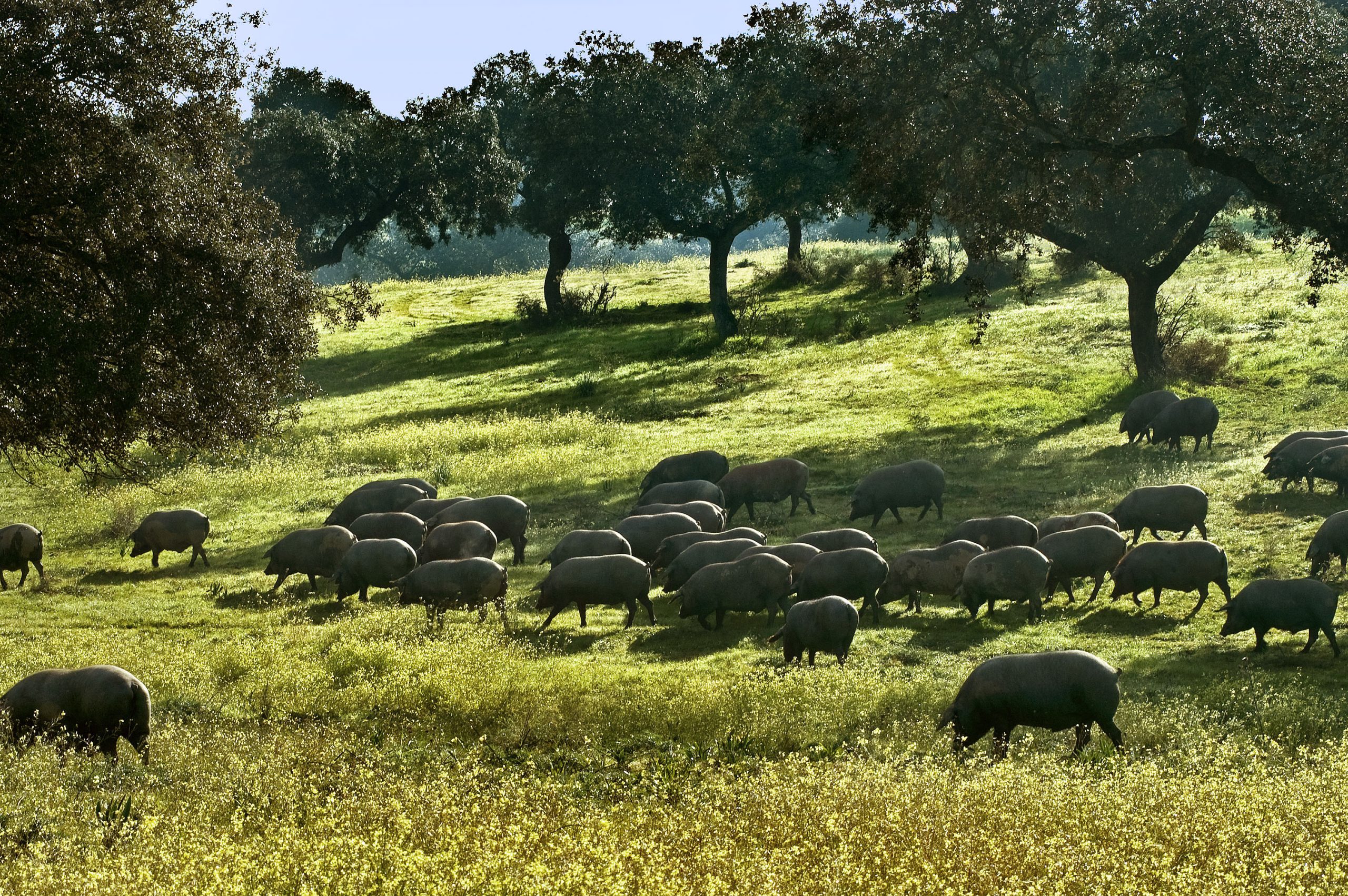
Classification of Pigs According to Their Diet

Acorn-Fed or Finished in Montanera
This refers to pigs destined for slaughter immediately after exclusively feeding on acorns, grass, and other natural resources from the dehesa, with no supplementary feed allowed. The batch of pigs must have an average entry weight into the montanera period between 92 and 115 kg and must be reared under this regime with no other type of feed permitted, with a minimum weight of 52 kg, during a minimum stay in the dehesa of over 60 days, and a minimum slaughter age of 14 months. The minimum individual carcass weight will be 115 kg, except for 100% Iberian animals, for which it will be 110 kg.

Field-Finished (Cebo de Campo) Pig
This pig’s fattening phase diet mainly consists of feed made up of cereals and legumes, managed in extensive farms, supplemented by a minimum 90-day period in open fields before slaughter. Feeding troughs must be at least 100 metres away from water sources, and the maximum density allowed is 15 pigs per hectare. The minimum slaughter age is 12 months. The minimum individual carcass weight will be 115 kg, except for 100% Iberian animals, for which it will be 110 kg.

The D.O.P. Dehesa de Extremadura distinguishes its certified products with two labels, according to the diet of the Iberian pigs.
Clasificación de producto DOP Dehesa de Extremadura
100% Iberian
The black label is placed on acorn-fed (bellota) 100% Iberian hams and shoulders, coming from purebred pigs raised freely in the dehesa and fed exclusively on acorns during the montanera season.
The PDO Dehesa de Extremadura certifies exclusively products from 100% Iberian pigs.
100% Iberian
The green label corresponds to Iberian field-fed hams and shoulders, produced from pigs raised outdoors and fed on feed and natural resources from the dehesa. Although their diet is not exclusively based on acorns, they maintain excellent quality thanks to their upbringing in a natural environment.

Production Process
Nº1
Salting
Although salting is a very simple technique, it involves a complex process where salt penetrates from the surface into the interior of the product, causing water to exit towards the outer layer due to the hygroscopic nature of the salt. The purpose is to incorporate common salt and curing salts into the muscle mass to promote dehydration and preservation of the pieces, while contributing to the development of the typical colour and aroma of cured products. This process takes place at a temperature between 1ºC and 5ºC and a relative humidity of around 80–99%. The salting time varies depending on weight and purity grade. As a general guideline, it can be approximately one day per kilo of weight.
Nº2
Washing
Once the salting process is complete, the salt adhered to the surface of the pieces is removed using cold or lukewarm water.
Resting
During this stage, the salt is evenly distributed throughout the pieces, and there is a slow, gradual elimination of surface water. This takes place in chambers at temperatures between 2ºC and 6ºC with relative humidity around 80–90%. The duration in these chambers depends on the weight of the pieces, typically ranging from 35 to 45 days. This phase can overlap with drying and maturation until natural environmental conditions of temperature and relative humidity are reached, ensuring the traditional production of the product.
Nº3
Drying and Maturation
This phase occurs in natural drying rooms equipped with windows that can be opened or closed to regulate ventilation, creating optimal humidity and temperature conditions. The product continues to dehydrate gradually, and exudation occurs (the diffusion of fat which is absorbed between muscle fibres, retaining the ham’s aroma). This is a very complex process, as the raw material undergoes many changes — some autolytic and others microbial — due to the fungal and bacterial flora present. These changes happen interactively, establishing a unique ecology favoured by the microclimates of the region.
Nº4
Aging in Cellars
After sorting the pieces by weight, quality, and shape, they are moved to cellars where the biochemical processes started in the previous phase continue with the intervention of microbial flora, which gives the product its distinctive aroma and flavour. The time spent in the cellars depends on the piece’s slaughter weight.
Nomenclature and Classification
NAME (% BREED)
1st SURNAME (FEEDING)
2nd SURNAME (P.D.O.)
Ham
100% Iberian
Acorn-Fed
P.D.O. Dehesa de Extremadura
Shoulder
100% Iberian
Acorn-Fed
P.D.O. Dehesa de Extremadura
Ham
100% Iberian
Field-Fed
P.D.O. Dehesa de Extremadura
Shoulder
100% Iberian
Field-Fed
P.D.O. Dehesa de Extremadura
CRDOP DEHESA DE EXTREMADURA
C / Cánovas del Castillo s/n 2ªplanta
Mérida (06800), Badajoz, España
El Consejo Regulador de la D.O.P. Dehesa de Extremadura ha sido beneficiario de una subvención de 129.959 €, cofinanciado por la Ministry of Agriculture, Livestock and Sustainable Development, para el apoyo a actividades de información y promoción en el mercado interior, en la convocatoria de ayuda a los regímenes de calidad de los productos agrícolas y alimentarios en el marco del PROYECTO DEHESA-IBORES CON CALIDAD DIFERENCIADA 2024-2025 en la Comunidad Autónoma de Extremadura. El objetivo es fomentar la producción y comercialización de productos agroalimentarios de calidad diferenciada (Decreto 79/2023 de 26 de julio, DOE nº 168 de 31/08/2023).
CO-FUNDED BY THE HONORABLE PROVINCIAL GOVERNMENT OF BADAJOZ
Years co-funded: 2021, 2022, 2023, 2024, 2025

CO-FUNDED BY THE HONORABLE PROVINCIAL GOVERNMENT OF CÁCERES
Years co-funded: 2021, 2022, 2023, 2024, 2025


Copyright © 2025 CRDOP DEHESA DE EXTREMADURA

